Astronomers using NASA’s Hubble Space Telescope, in combination with the European Space Agency’s Euclid observatory and the Subaru Telescope in Hawaii, have identified one of the most extraordinary galaxies ever detected: a nearly invisible object called CDG-2 that appears to be composed of approximately 99 percent dark matter, with barely a trace of the stars and gas that make normal galaxies shine.
The discovery, published in The Astrophysical Journal Letters in February 2026, represents a landmark in the study of dark matter, the invisible substance that makes up roughly 27 percent of the universe’s total mass-energy content but has never been directly detected. While all galaxies contain dark matter, typically outweighing visible matter by about five to one, CDG-2 takes this imbalance to an extraordinary extreme. (Sources: The Astrophysical Journal Letters, NASA Science)
Finding the Invisible
Detecting CDG-2 required an entirely new approach. David Li, a postdoctoral researcher at the University of Toronto who led the study, and his team could not search for the galaxy directly because it is far too faint. Instead, they looked for globular clusters, the dense, spherical collections of stars that typically orbit galaxies and can serve as cosmic breadcrumbs pointing to hidden stellar populations. (Source: NASA Science)
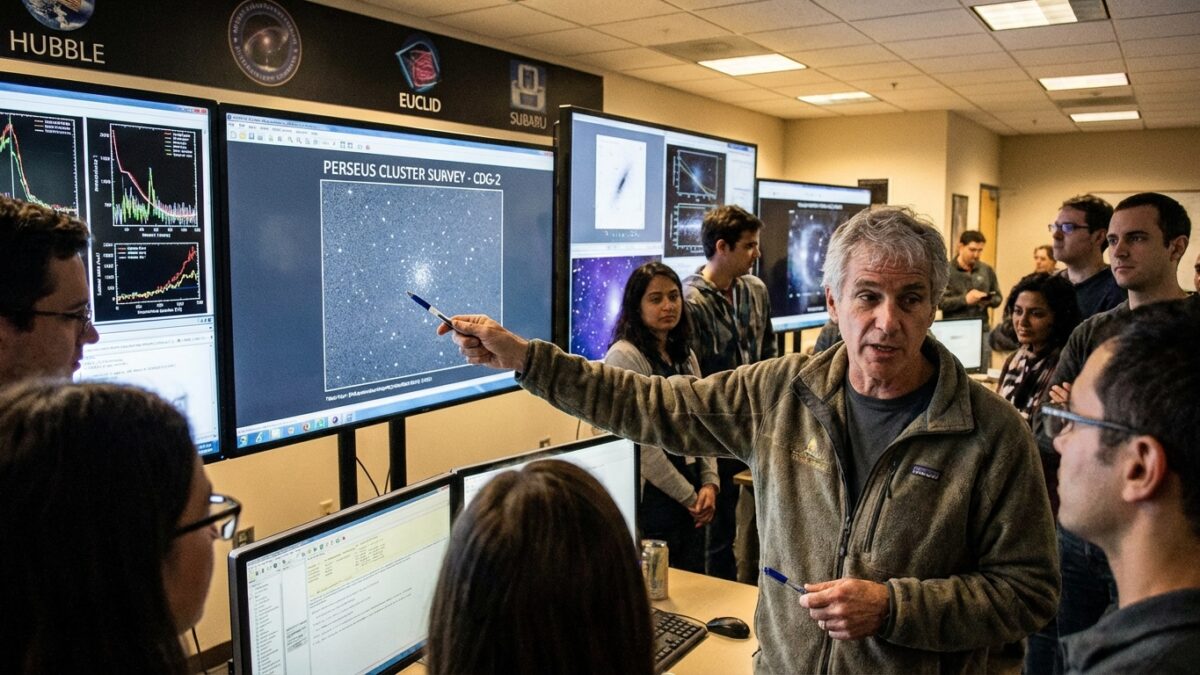
Using advanced statistical techniques, the team identified tight groupings of globular clusters in the Perseus galaxy cluster, located approximately 300 million light-years from Earth. One grouping of four unusually close globular clusters caught their attention, and follow-up observations with Hubble, Euclid, and Subaru revealed a faint, diffuse glow surrounding the clusters, strong evidence of an underlying galaxy. (Source: ESA Hubble)
Li described CDG-2 as the first galaxy ever detected solely through its globular cluster population. Under conservative assumptions, those four clusters represent the entirety of the galaxy’s globular cluster system, compared to more than 150 in the Milky Way. (Source: NASA Science)
The Dark Matter Puzzle
Preliminary analysis suggests CDG-2 shines with the combined light of roughly six million Sun-like stars, an extraordinarily dim output for a galaxy. The four globular clusters account for a remarkable 16 percent of all the visible light in the system. Most strikingly, approximately 99 percent of the galaxy’s total mass appears to consist of dark matter. (Source: ScienceDaily)
Much of the ordinary matter that would normally fuel star formation, primarily hydrogen gas, was likely stripped away through gravitational interactions with other galaxies in the dense Perseus cluster environment. What remains is essentially a dark matter skeleton with only the faintest veneer of visible stars. (Source: NASA Science)
Francine Marleau, from the Institute for Astro- and Particle Physics at the University of Innsbruck in Austria, highlighted the role of the Euclid telescope in confirming the discovery. She noted that Euclid’s images of the Perseus cluster demonstrate the mission’s unique capability to detect extremely faint low-surface-brightness galaxies while also revealing their internal structures. (Source: ESA)
Why It Matters
Dark matter-dominated galaxies like CDG-2 are important because they provide natural laboratories for studying dark matter in isolation. In normal galaxies, the gravitational effects of dark matter are intertwined with those of visible matter, making it difficult to disentangle their respective contributions. In a galaxy where visible matter accounts for just one percent of the total mass, researchers can study the behavior and distribution of dark matter with far less contamination from ordinary material.
Li, who has been surprised by the global attention the discovery has received, told Canadian media that he hopes to find more dark galaxies because they could unlock new clues about the nature of dark matter, one of the most fundamental unsolved problems in physics. (Source: CP24)
The Future of Dark Galaxy Hunting
As sky surveys expand with missions such as Euclid, NASA’s upcoming Nancy Grace Roman Space Telescope, and the Vera C. Rubin Observatory, astronomers are increasingly turning to machine learning and advanced statistical methods to sift through enormous datasets for signatures of these nearly invisible objects. The techniques pioneered in the CDG-2 discovery will be applied to far larger volumes of data, potentially revealing an entire population of dark galaxies that has been hiding in plain sight. (Source: NASA Science)
The Hubble Space Telescope, which has operated for more than three decades, continues to produce groundbreaking discoveries. CDG-2 is a testament to the power of combining Hubble’s precision with next-generation observatories, demonstrating that some of the universe’s most profound secrets are hiding not in brilliant light but in the deepest shadows.
Theoretical Implications
The existence of galaxies as dark matter-dominated as CDG-2 poses interesting challenges for theoretical models of galaxy formation. Standard cosmological models predict that dark matter halos of various sizes should form throughout the universe, with visible galaxies developing within the larger halos where gas can cool and condense into stars. CDG-2 appears to represent a case where this process was almost entirely disrupted, likely by the harsh environment of the dense Perseus cluster stripping away the gas before significant star formation could occur.
Understanding how common such objects are could provide important constraints on dark matter models. If dark galaxies are abundant, it would suggest that the relationship between dark matter halos and visible galaxies is more complex than current models assume. Alternatively, if they are extremely rare, it would confirm that the conditions needed to produce such extreme objects are unusual. The answer has implications for our understanding of the total mass budget of the universe and the role of environment in galaxy evolution.